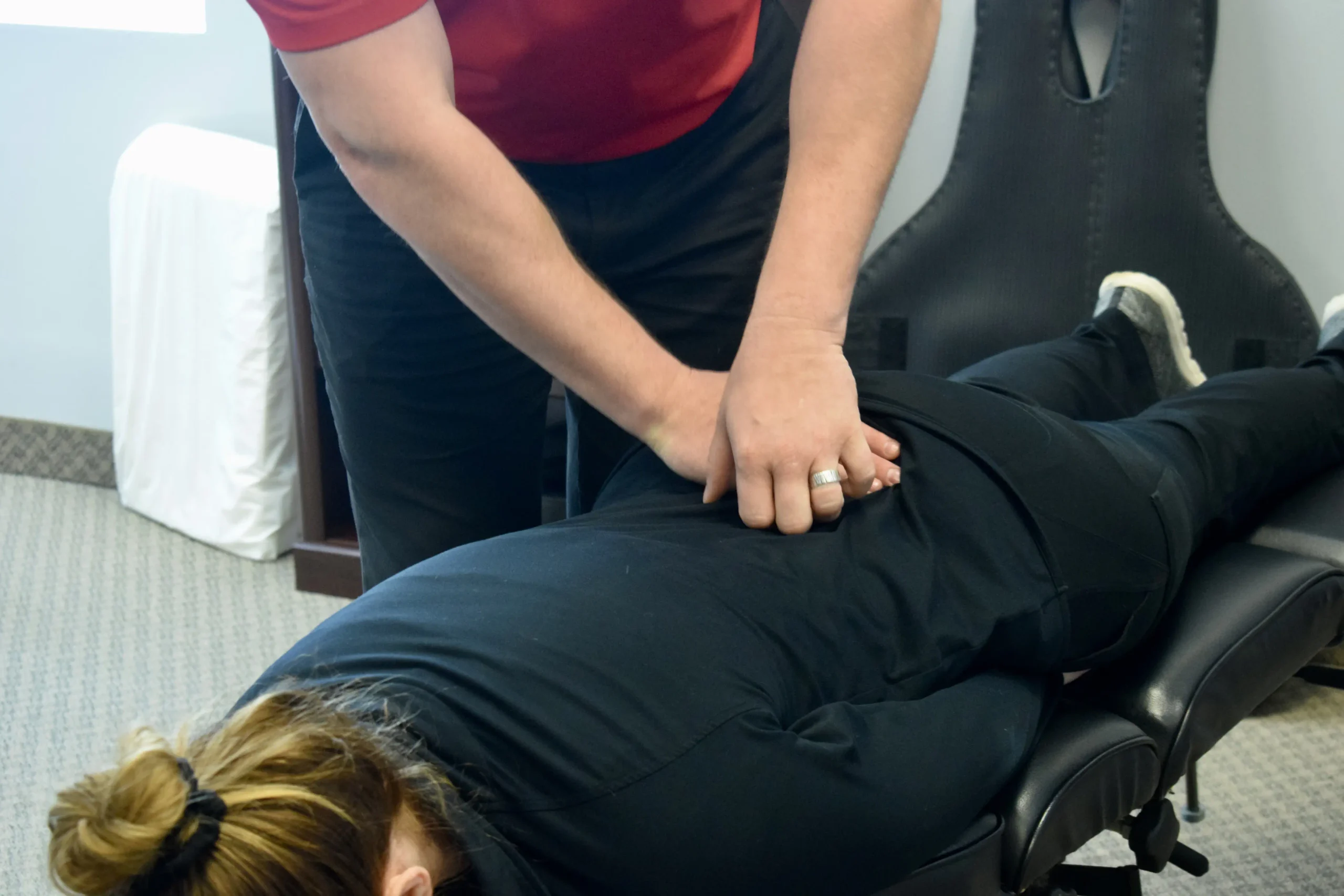
Shoulder pain when lifting your arm can make simple movements—reaching into a cabinet, putting on a shirt, washing your hair, or completing an overhead exercise—surprisingly difficult.
The location and timing of the pain can provide useful clues. Pain during the middle portion of an overhead movement may involve the rotator cuff or nearby bursa. Pain and stiffness in nearly every direction may suggest frozen shoulder or arthritis. Sudden pain and weakness after an injury can be more concerning for a significant tendon injury, fracture, or dislocation.
However, one painful movement cannot identify the cause by itself. Shoulder symptoms can originate from the joint, tendons, muscles, surrounding tissues, or even the neck. Team Chiropractic evaluates the complete pattern before recommending care.
Why Does Your Shoulder Hurt When You Raise Your Arm?
The shoulder allows more movement than almost any other joint. That mobility depends on coordinated motion among the upper-arm bone, shoulder blade, collarbone, rotator cuff, and surrounding muscles.
When you lift your arm, several things need to happen:
- The upper-arm bone must move within the shoulder socket.
- The shoulder blade must rotate and glide along the rib cage.
- The rotator cuff must help control and center the joint.
- The surrounding muscles must create force without excessive strain.
- The neck and upper back must provide a stable, comfortable base.
Pain may appear when one of these structures is irritated, injured, stiff, overloaded, or not coordinating effectively with the others.
The painful area does not always reveal the exact source. Rotator cuff symptoms, for example, are frequently felt along the outside of the upper arm rather than directly over the injured tendon.
Pay Attention to When the Pain Occurs
The point in the movement where pain begins can help guide an examination.
Pain as You Begin Lifting
Pain during the first part of the movement may occur when the rotator cuff is irritated or when initiating the motion requires more effort than usual. Significant difficulty starting the movement after an injury deserves prompt evaluation.
Pain in the Middle of the Movement
Some people experience a “painful arc,” meaning the shoulder hurts during the middle portion of lifting but becomes less painful once the arm is higher. This pattern may occur with rotator cuff or subacromial problems, but it does not confirm a specific diagnosis by itself.
Pain Near the Top of the Movement
Pain near the end of an overhead reach may involve the shoulder joint, the acromioclavicular joint at the top of the shoulder, limited upper-back mobility, or irritation caused by repeated overhead activity.
Pain While Lowering the Arm
Pain, catching, or difficulty controlling the arm as it lowers can also involve the rotator cuff. If the arm suddenly drops or cannot be controlled after an injury, seek an evaluation rather than repeatedly testing it.
Common Causes of Shoulder Pain When Lifting Your Arm
Several conditions can make raising an arm painful. Some can occur together, which is another reason an examination is more useful than trying to select one diagnosis from a symptom list.
Rotator Cuff Irritation or Injury
The rotator cuff is a group of muscles and tendons that helps stabilize and move the shoulder. These tissues may become irritated through repetitive activity, an abrupt increase in exercise, overhead work, a fall, or gradual age-related changes.
Possible symptoms include:
- Pain along the outside or front of the shoulder
- Discomfort when reaching overhead
- Pain when reaching behind the back
- Night pain, especially when lying on the affected side
- Weakness or pain when lifting an object
- Symptoms during throwing, pressing, or pulling exercises
Rotator cuff problems range from temporary irritation to partial or complete tears. Pain intensity alone cannot determine the extent of an injury.
Subacromial Bursitis
A bursa is a small, fluid-filled structure that helps reduce friction between moving tissues. The bursa above the rotator cuff may become irritated and painful, particularly during overhead motion.
Bursitis and rotator cuff problems commonly overlap. Both may produce tenderness, night pain, and discomfort while lifting the arm through a particular range.
Frozen Shoulder
Frozen shoulder, also called adhesive capsulitis, causes pain and a progressive loss of shoulder motion. Reaching overhead, rotating the arm outward, and placing the hand behind the back may become increasingly difficult.
One important clue is that both active movement—when you lift the arm yourself—and passive movement—when someone else carefully moves it—are restricted. Frozen shoulder is characterized by pain and decreased range of motion, particularly with outward rotation.
Frozen shoulder may develop without a clear injury, although it is more common following a period of immobilization and among people with certain health conditions, including diabetes or thyroid disorders.
Shoulder Arthritis
Arthritis can cause pain, stiffness, grinding, and a gradual loss of movement. Symptoms may be more noticeable in the morning, after inactivity, or near the end of the available range of motion.
Arthritis affecting the main shoulder joint can make movement difficult in several directions. Arthritis in the acromioclavicular joint may cause more focused pain at the top of the shoulder, particularly when reaching across the body.
Biceps Tendon Irritation
The long head of the biceps tendon crosses the front of the shoulder. Irritation may cause pain near the front of the joint that becomes more noticeable during lifting, carrying, pulling, or reaching overhead.
Because several shoulder structures occupy the same region, front-of-shoulder pain should not automatically be labeled biceps tendinitis without an examination.
Shoulder Instability or Labral Injury
The labrum is a ring of tissue that helps deepen the shoulder socket. An injury may occur during a fall, dislocation, forceful pull, or repetitive overhead activity.
Possible symptoms include:
- Deep shoulder pain
- Clicking, catching, or locking
- A sensation that the shoulder may slip
- Pain during throwing or overhead lifting
- Reduced confidence using the arm in certain positions
These symptoms can resemble other shoulder problems. Advanced imaging or an orthopedic evaluation may be necessary when a significant labral injury or instability is suspected.
Could the Pain Be Coming From Your Neck?
Yes. Pain felt around the shoulder does not always begin in the shoulder itself.
Irritation of a nerve in the neck may produce pain around the shoulder blade, shoulder, arm, or hand. Neck-related symptoms are more likely when shoulder pain occurs with:
- Neck pain or stiffness
- Tingling or numbness
- Pain traveling past the elbow
- Hand or arm weakness
- Symptoms affected by neck position
- Burning or electric sensations
Pain that radiates beyond the elbow, particularly with numbness or tingling, increases concern for a cervical source rather than an isolated shoulder problem.
Team Chiropractic may evaluate both the neck and shoulder when the symptom pattern makes the source unclear. Readers experiencing accompanying neck symptoms can also learn more about neck pain evaluation and care.
What If the Pain Started After Exercise?
Shoulder pain frequently appears after pressing, throwing, swimming, climbing, racket sports, or other activities requiring repeated arm movement.
Consider what changed before symptoms began:
- Did you increase the weight, volume, or frequency?
- Did you add a new exercise or activity?
- Did your technique change as you became tired?
- Was there a sudden pull, fall, collision, or awkward repetition?
- Does the shoulder hurt only under load or during ordinary movement too?
- Is strength noticeably different from the opposite side?
Temporary muscle soreness usually improves and does not produce sharp joint pain, significant weakness, or a major loss of motion. Continuing to load a painful shoulder heavily in hopes of “working through it” may further aggravate an injury.
Team Chiropractic provides evaluation for sports injuries and activity-related pain, including shoulder concerns affecting training, work, or recreational activity.
Should You Keep Moving a Painful Shoulder?
Complete immobilization is not automatically the best response, but repeatedly forcing painful overhead movement is not helpful either.
Until the cause is evaluated:
- Temporarily reduce movements that create sharp or increasing pain.
- Avoid repeatedly testing the painful range.
- Keep the arm moving gently within a comfortable range.
- Do not force aggressive stretches into stiffness.
- Reduce heavy overhead pressing, throwing, or lifting.
- Support the arm comfortably while sleeping if needed.
- Note which movements, positions, and times of day affect the symptoms.
A generic online shoulder routine may be inappropriate if the problem involves a tear, instability, fracture, frozen shoulder, or referred neck pain. Exercise selection should reflect the likely cause and current level of function.
How Team Chiropractic Evaluates Shoulder Pain
Shoulder evaluation involves more than asking where it hurts. Team Chiropractic considers how the symptoms began, how the shoulder moves, and whether the problem may originate elsewhere.
Symptom and Injury History
Your doctor will ask when the pain began, whether an injury occurred, which activities reproduce it, and whether you have noticed weakness, stiffness, clicking, numbness, or night pain.
Active and Passive Movement
You may be asked to move the arm in several directions. The doctor may then carefully move it for you. Comparing active and passive motion can help distinguish pain-limited movement from broader joint stiffness.
Strength and Orthopedic Testing
Selected movements may be used to assess rotator cuff function, shoulder stability, the biceps tendon, the acromioclavicular joint, and other structures. One positive test rarely confirms a diagnosis, so findings are interpreted together.
Neck, Shoulder Blade, and Upper-Back Assessment
The examination may include neck motion, neurological function, shoulder-blade movement, upper-back mobility, and muscular control. This helps determine whether the painful shoulder is the primary source or part of a larger movement pattern.
Will Shoulder Pain Require Imaging?
Not everyone with shoulder pain needs immediate imaging. The decision depends on how the symptoms began, how long they have lasted, whether trauma occurred, and what the examination finds.
X-rays may be useful for evaluating fractures, arthritis, joint position, and certain bone-related changes. Team Chiropractic can take X-rays when they are clinically appropriate.
However, X-rays do not directly show every tendon, muscle, labral, or nerve injury. Ultrasound or MRI may be considered when a significant rotator cuff tear, labral injury, or another soft-tissue problem is suspected. Imaging recommendations vary according to the suspected condition and whether the results would affect management.
When advanced imaging or medical evaluation is appropriate, Team Chiropractic can explain the concern and recommend the next step.
Care That May Be Included
Recommendations depend on the source and severity of the pain. Chiropractic treatment is not appropriate for every shoulder injury, and no individual service is automatically included.
Chiropractic Adjustments
Selected chiropractic adjustments may address restricted movement in the neck, upper back, shoulder girdle, or other contributing joints. Treatment should be adapted to the patient and should not be used as a substitute for necessary orthopedic care.
Soft-Tissue Release
Soft-tissue release may be considered when muscular tension or restricted tissue movement contributes to shoulder discomfort. The affected tissue and appropriate amount of pressure should be determined through examination.
Sports Rehabilitation
Sports rehabilitation may include progressive mobility, strengthening, stability, and activity-specific exercises. The plan may address both the painful shoulder and the surrounding areas needed for safe lifting, throwing, or overhead movement.
K-Laser Therapy
K-Laser therapy may be incorporated for selected musculoskeletal conditions when clinically appropriate. It should be one component of an individualized plan rather than presented as a guaranteed solution for every type of shoulder pain.
Shockwave Therapy
Shockwave therapy may be considered for certain persistent tendon problems. It is not suitable for every shoulder condition, and appropriateness depends on the diagnosis, health history, and available evidence.
Service availability can vary by office. Team Chiropractic will explain which options are available and why a particular service is or is not being recommended.
When Shoulder Pain Needs Prompt Medical Attention
Seek timely medical care if:
- The pain began after a significant fall, collision, or other trauma.
- The shoulder appears deformed or out of position.
- You cannot lift the arm after an injury.
- Sudden weakness developed during a lift or overhead movement.
- The arm or hand becomes cold, pale, blue, or severely swollen.
- Redness, warmth, fever, or illness accompanies the pain.
- Numbness or weakness is worsening.
- Chest pressure, shortness of breath, sweating, nausea, or jaw pain occurs with shoulder or arm discomfort.
Call emergency services for possible heart-related symptoms, a major traumatic injury, or rapidly progressing neurological symptoms.
When Should You Schedule an Evaluation?
Consider having your shoulder evaluated when pain:
- Continues for more than several days without improvement
- Repeatedly returns during the same movement
- Interferes with sleep
- Prevents normal work, exercise, or personal care
- Is accompanied by weakness or reduced motion
- Began after an injury
- Extends into the arm with tingling or numbness
Team Chiropractic evaluates shoulder and other joint pain at its Raleigh and Wakefield offices. The goal is to identify the likely source, determine whether conservative care is appropriate, and coordinate medical care when necessary.
A free consultation allows you to discuss your concern and learn whether Team Chiropractic may be an appropriate place to begin. Any examination, imaging, or treatment is separate and will be explained before proceeding.
Frequently Asked Questions
Why does my shoulder hurt only when I lift my arm?
Lifting the arm places coordinated demands on the shoulder joint, rotator cuff, bursa, shoulder blade, and surrounding muscles. Pain during this movement may reflect irritation, stiffness, injury, or altered shoulder mechanics. An examination is needed to distinguish among the possible causes.
What is a painful arc?
A painful arc describes discomfort that appears during part of an overhead movement, often through the middle of the motion. It can occur with rotator cuff or subacromial problems, but it is not a diagnosis by itself.
Does shoulder pain when lifting the arm mean I have a rotator cuff tear?
Not necessarily. Rotator cuff irritation, bursitis, frozen shoulder, arthritis, biceps tendon problems, and referred neck pain can all make lifting painful. Even confirmed rotator cuff abnormalities do not always require surgery.
What does a rotator cuff injury feel like?
Possible symptoms include pain along the front or outside of the shoulder, pain during overhead activity, night pain, and weakness while lifting or rotating the arm. These findings overlap with other conditions, so they cannot confirm an injury alone.
Why does my shoulder hurt at night?
Night pain can occur with rotator cuff problems, bursitis, frozen shoulder, arthritis, or direct pressure from sleeping on the affected side. Persistent pain that regularly interrupts sleep should be evaluated.
Is shoulder pain related to the neck?
It can be. Neck-related nerve irritation may cause shoulder or arm pain, numbness, tingling, burning, or weakness. Pain extending beyond the elbow or changing with neck position makes a cervical source more important to consider.
Should I stretch a painful shoulder?
Gentle movement within a comfortable range may be appropriate, but aggressive stretching can aggravate certain injuries or irritate a stiff joint. It is better to understand the likely cause before repeatedly forcing the shoulder through pain.
Can a chiropractor treat shoulder pain?
Chiropractic care may be appropriate for some musculoskeletal causes of shoulder pain. Care might include joint treatment, soft-tissue techniques, rehabilitation, or another available service. Fractures, dislocations, significant tendon tears, infections, and other medical conditions require appropriate referral or coordinated care.
Will I need an X-ray or MRI?
Not every case requires imaging. X-rays may be appropriate following trauma or when arthritis, fracture, or another bone-related problem is suspected. MRI or ultrasound may be considered for certain tendon, labral, or soft-tissue concerns.
How long does shoulder pain take to improve?
Recovery depends on the cause, severity, duration, activity demands, and care provided. A mild irritation may improve relatively quickly, while frozen shoulder, a significant tendon injury, or a recurring sports-related problem may require a longer recovery process.